National Institutes of Health/National Institute of General Medical Sciences (NIH/NIGMS)
米国
引用
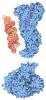
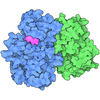
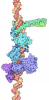
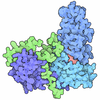
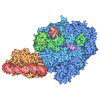
ジャーナル: Proc Natl Acad Sci U S A / 年: 2025 タイトル: Neurodevelopmental disorder-linked Argonaute mutations permit delayed RISC formation and unusual shortening of miRNAs by 3'→5' trimming. 著者: Andrew Savidge / Huaqun Zhang / Vishal Annasaheb Adhav / Audrey C Kehling / GeunYoung Sim / Zhangfei Shen / Tian-Min Fu / Kotaro Nakanishi / 要旨: Mutations in Argonaute proteins (AGOs) cause Argonaute syndrome, a neurodevelopmental disorder (NDD), yet the underlying molecular mechanism remains unclear. We determined cryo-electron microscopy ...Mutations in Argonaute proteins (AGOs) cause Argonaute syndrome, a neurodevelopmental disorder (NDD), yet the underlying molecular mechanism remains unclear. We determined cryo-electron microscopy (cryo-EM) structures of wild-type (WT) AGO1 and the recurrent, severe causative ΔF180 mutant. AGO1(ΔF180) unexpectedly rearranges the hydrophobic core of the L1 domain to preserve the overall RNA-induced silencing complexes (RISC) architecture and recognize guide RNAs similarly to WT. Functionally, the mutant binds target RNAs like WT but more frequently retains passenger strands, implicating a defect in RISC assembly. Biochemical assays of ΔF180 and L190P mutants revealed normal duplex loading but impaired passenger ejection, exposing guide 3' ends to 3'→5' exonucleases and generating abnormally short ~11-nucleotide RNAs. In cells, AGO1(ΔF180), AGO1(G199S), and corresponding AGO2 mutants likewise produced truncated guides. Together, these findings support a model in which defective passenger ejection underlies the pathology of AGO-associated NDDs by rendering microRNAs bound to AGO syndrome mutants susceptible to aberrant 3' trimming.
 ムービー
 コントローラー


 データを開く

 基本情報

 マップデータ
 試料
 キーワード
 機能・相同性情報
 Homo sapiens (ヒト) /
 Trichoplusia ni (イラクサキンウワバ)
 データ登録者
 米国, 1件
 引用
 構造の表示

 ダウンロードとリンク
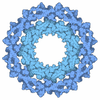
 emd_72192.png
 https://data.pdbj.org/pub/emdb/structures/EMD-72192


 Z (Sec.)
 Y (Row.)
 X (Col.)


 試料の構成要素
 解析
 電子顕微鏡法
 FIELD EMISSION GUN