H2020 Marie Curie Actions of the European Commission
European Union
引用
ジャーナル: Cell / 年: 2025 タイトル: A split-site E3 ligase mechanism enables ZNFX1 to ubiquitinate and cluster single-stranded RNA into ubiquitin-coated nucleoprotein particles. 著者: Daniel B Grabarczyk / Eric J Aird / Vanessa Reznikow / Paul C Kirchgatterer / Julian F Ehrmann / Robert Kurzbauer / Lillie E Bell / Max J Kellner / Ritika Aggarwal / Alexander Schleiffer / ...著者: Daniel B Grabarczyk / Eric J Aird / Vanessa Reznikow / Paul C Kirchgatterer / Julian F Ehrmann / Robert Kurzbauer / Lillie E Bell / Max J Kellner / Ritika Aggarwal / Alexander Schleiffer / Victoria Faas / Luiza Deszcz / Anton Meinhart / Gijs A Versteeg / Josef M Penninger / Lukas S Stelzl / Moritz M Gaidt / Ingrid Tessmer / Jacob E Corn / Tim Clausen / 要旨: Eukaryotic cells use a multi-layered immune response to combat intracellular pathogens. The ubiquitin ligase ZNFX1 has emerged as a crucial yet little understood player that regulates the immune ...Eukaryotic cells use a multi-layered immune response to combat intracellular pathogens. The ubiquitin ligase ZNFX1 has emerged as a crucial yet little understood player that regulates the immune response while protecting against RNA viruses. Our study unveils the molecular mechanism of ZNFX1, mediated by the joint activity of a helicase serving as a nucleic acid sensor and a non-conventional E3 module featuring a split active site. We demonstrate that single-stranded RNA stimulates E3 activity by fostering dimerization of ZNFX1 subunits that translocate along nucleic acid tracks. Juxtaposed E3 domains complement each other, leading to the ubiquitination of ZNFX1 itself and engaged RNA molecules, while clustering nucleic acids into dense nucleoprotein particles. We show that the E3 ligase activity of ZNFX1 protects cells during an immune response and propose that ubiquitin-coated particles formed by ZNFX1 represent part of an ancient mechanism to regulate both foreign and host RNA in the cell.
 ムービー
ムービー コントローラー


 データを開く
 基本情報
基本情報
 マップデータ
 試料
試料 キーワード
キーワード 機能・相同性情報
 Homo sapiens (ヒト)
 データ登録者
 オーストリア, European Union, 2件
  引用
引用

 構造の表示
構造の表示
 ダウンロードとリンク
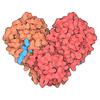
 emd_52968.png
 http://ftp.pdbj.org/pub/emdb/structures/EMD-52968

 Z (Sec.)
 Y (Row.)
 X (Col.)


 試料の構成要素
 Trichoplusia ni (イラクサキンウワバ)
 解析
解析 電子顕微鏡法
 FIELD EMISSION GUN

