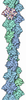
- EMDB-100131: Paired helical filament from Alzheimer's disease brain (AD seed) -
+
Open data
ID or keywords:
Loading...
-
Basic information
Entry
Database: EMDB / ID: EMD-100131
Title
Paired helical filament from Alzheimer's disease brain (AD seed)
Map data
Sample
Tissue: Paired helical filament from Alzheimer's disease brain (AD seed)
Protein or peptide: Microtubule-associated protein tau
Keywords
tau / paired helical filament / Alzheimer's / PROTEIN FIBRIL
Function / homology
Function and homology information
plus-end-directed organelle transport along microtubule / histone-dependent DNA binding / microtubule stabilizing activity / neurofibrillary tangle / microtubule lateral binding / axonal transport / tubulin complex / positive regulation of protein localization to synapse / generation of neurons / phosphatidylinositol bisphosphate binding ...plus-end-directed organelle transport along microtubule / histone-dependent DNA binding / microtubule stabilizing activity / neurofibrillary tangle / microtubule lateral binding / axonal transport / tubulin complex / positive regulation of protein localization to synapse / generation of neurons / phosphatidylinositol bisphosphate binding / axonal transport of mitochondrion / axon development / rRNA metabolic process / central nervous system neuron development / regulation of microtubule-based movement / negative regulation of protein localization to mitochondrion / regulation of mitochondrial fission / regulation of chromosome organization / intracellular distribution of mitochondria / minor groove of adenine-thymine-rich DNA binding / lipoprotein particle binding / negative regulation of mitochondrial membrane potential / microtubule polymerization / regulation of microtubule polymerization / dynactin binding / apolipoprotein binding / regulation of calcium-mediated signaling / main axon / Caspase-mediated cleavage of cytoskeletal proteins / glial cell projection / regulation of microtubule polymerization or depolymerization / neurofibrillary tangle assembly / negative regulation of mitochondrial fission / protein polymerization / positive regulation of axon extension / axolemma / regulation of cellular response to heat / positive regulation of microtubule polymerization / positive regulation of superoxide anion generation / cytoplasmic microtubule organization / Activation of AMPK downstream of NMDARs / cellular response to brain-derived neurotrophic factor stimulus / regulation of long-term synaptic depression / axon cytoplasm / positive regulation of protein localization / synapse assembly / somatodendritic compartment / supramolecular fiber organization / astrocyte activation / nuclear periphery / phosphatidylinositol binding / protein phosphatase 2A binding / stress granule assembly / enzyme inhibitor activity / SH3 domain binding / cellular response to reactive oxygen species / microtubule cytoskeleton organization / regulation of microtubule cytoskeleton organization / cellular response to nerve growth factor stimulus / memory / microglial cell activation / Hsp90 protein binding / regulation of autophagy / regulation of synaptic plasticity / protein homooligomerization / synapse organization / response to lead ion / PKR-mediated signaling / neuron projection development / cytoplasmic ribonucleoprotein granule / microtubule cytoskeleton / cell-cell signaling / cellular response to heat / single-stranded DNA binding / actin binding / protein-folding chaperone binding / growth cone / double-stranded DNA binding / cell body / sequence-specific DNA binding / microtubule binding / amyloid fibril formation / dendritic spine / learning or memory / protein-macromolecule adaptor activity / membrane raft / negative regulation of gene expression / axon / neuronal cell body / DNA damage response / dendrite / protein kinase binding / enzyme binding / mitochondrion / DNA binding / RNA binding / extracellular region / identical protein binding / nucleus / plasma membrane Similarity search - Function
Microtubule-associated protein Tau / Microtubule associated protein, tubulin-binding repeat / Tau and MAP protein, tubulin-binding repeat / Tau and MAP proteins tubulin-binding repeat signature. / Tau and MAP proteins tubulin-binding repeat profile. / : Similarity search - Domain/homology
Journal: bioRxiv / Year: 2026 Title: Templated paired helical filament formation and tau fold-dependent inclusion morphologies in primary neurons. Authors: Melissa Huang / Sofia Lövestam / Kimberly Ai Xian Cheam / Bernardino Ghetti / William A McEwan / Sjors H W Scheres / Michel Goedert / Abstract: Neurodegenerative tauopathies are characterized by the abnormal assembly of tau into amyloid filaments with distinct, disease-specific folds. These filaments are proposed to spread in a prion-like ...Neurodegenerative tauopathies are characterized by the abnormal assembly of tau into amyloid filaments with distinct, disease-specific folds. These filaments are proposed to spread in a prion-like manner, thus underlying the progression of pathology in diseased brains. A prediction of this hypothesis is that tau filaments will induce progeny filaments identical to the input seed material, yet cellular models of templated tau assembly have failed to fully recapitulate brain-derived filament structures. Here, we show that mixed primary mouse cortical neurons overexpressing full-length human tau via adeno-associated virus transduction propagate Alzheimer's disease paired helical filaments upon exposure to human brain-derived seeds. Using minimal tags and core mutations, we were able to unambiguously differentiate induced aggregates from the original seeds. Super-resolution microscopy and live-cell imaging revealed progressive inclusion formation in neurons. Moreover, seeding primary neurons with brain extracts from individuals with Pick's disease, corticobasal degeneration and progressive supranuclear palsy induced the formation of morphologically distinct inclusions. Together, these findings establish that primary neurons provide an environment for the faithful propagation of paired helical filaments and show that tau filament folds dictate higher-order inclusion morphologies within neurons.
In the structure databanks used in Yorodumi, some data are registered as the other names, "COVID-19 virus" and "2019-nCoV". Here are the details of the virus and the list of structure data.
Jan 31, 2019. EMDB accession codes are about to change! (news from PDBe EMDB page)
EMDB accession codes are about to change! (news from PDBe EMDB page)
The allocation of 4 digits for EMDB accession codes will soon come to an end. Whilst these codes will remain in use, new EMDB accession codes will include an additional digit and will expand incrementally as the available range of codes is exhausted. The current 4-digit format prefixed with “EMD-” (i.e. EMD-XXXX) will advance to a 5-digit format (i.e. EMD-XXXXX), and so on. It is currently estimated that the 4-digit codes will be depleted around Spring 2019, at which point the 5-digit format will come into force.
The EM Navigator/Yorodumi systems omit the EMD- prefix.
Related info.:Q: What is EMD? / ID/Accession-code notation in Yorodumi/EM Navigator
Yorodumi is a browser for structure data from EMDB, PDB, SASBDB, etc.
This page is also the successor to EM Navigator detail page, and also detail information page/front-end page for Omokage search.
The word "yorodu" (or yorozu) is an old Japanese word meaning "ten thousand". "mi" (miru) is to see.
Related info.:EMDB / PDB / SASBDB / Comparison of 3 databanks / Yorodumi Search / Aug 31, 2016. New EM Navigator & Yorodumi / Yorodumi Papers / Jmol/JSmol / Function and homology information / Changes in new EM Navigator and Yorodumi
 Movie
 Controller


 Yorodumi
 Open data

 Basic information

 Map data
 Sample
 Keywords
 Function and homology information
 Homo sapiens (human)
 Authors
 United Kingdom, 1 items
 Citation

 Structure visualization

 Downloads & links
 emd_100131.png
 https://data.pdbj.org/pub/emdb/structures/EMD-100131


 Z (Sec.)
 Y (Row.)
 X (Col.)


 Sample components
 Processing
 Electron microscopy
 FIELD EMISSION GUN